
On her second day of life, they were able to perform the surgery that would either save her or, at least, prolong her life. And although there was still much left to discover, the doctors began to tell us the things that Georgia would NEVER be able to do. “She will never be able to eat. She will depend her entire life on a tube that feeds her through the vein closest to her heart, always at risk of infection and sepsis. She will never be able to go to the bathroom like normal people; she will need help to urinate and have bowel movements because her intestines do not move and her bladder does not function. Also, her kidneys will only work at 33%. We don’t know if her stomach will function properly, so just in case, we placed a gastric tube to assist with feeding, which will be liquid formula because she will never be able to eat solid food. She will suffer from malnutrition, which will prevent her from developing properly, and most likely, she will die from it as well.”
Days and Nights in the Hospital
While other new mothers cried tears of joy, I was drowning in anguish, pain, and terror. On top of it all, every conversation, every diagnosis, every word was spoken in a language that wasn’t my own — making an already heartbreaking reality feel even more distant, more confusing, more overwhelming.
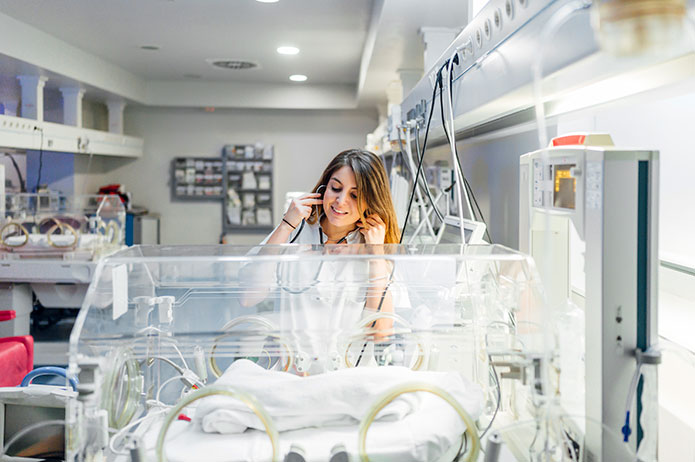
They allowed me to stay at the hospital for two weeks, living in a small room down the hallway from the intensive care unit. I could visit my baby whenever I wanted; I could express the milk from my full breasts, even though the doctors said I would never be able to feed it to her. That milk tasted like tears, but it also tasted like faith, like hope. I remember so clearly that with every pumping session, I spoke to my body, I spoke to the spiritual world that listens, and to the Creator of that world — telling Him that Georgia, the little girl He had given me, the one who had grown inside my womb, would one day be nourished not through a tube, but by my milk. The milk my body was making, the milk that would one day fill her, nourish her, and help her grow strong.
No words were encouraging. We spent hours in meetings with the doctors, only to end up without any real conclusions or clear plans. I know they were doing their best, and I also understand that their duty was to speak about the patient as honestly and accurately as possible, based on her medical condition. But their tone — though professional — felt so cold, even if their manner was kind. I must have sounded crazy so many times. And yet, I believed the words I spoke out loud so deeply that one day… I saw it come true. But that is a story for another chapter.
As I was telling you, I must have seemed crazy so many times. In those meetings where doctors would often use the word “NEVER,” I would respond with the phrase, “YES, SHE WILL. SHE WILL DO IT!!” I remember one doctor getting quite upset when she saw how my face changed as I spoke — always saying the opposite of what she was declaring. She could read it in my expression (because I’m not very good at hiding my feelings). While she was speaking tragedy in English, I was declaring victory in Spanish.
Battle of Words and Faith
From that moment on, I understood that we had entered a war of words — words launched into the spiritual world, into the universe, or however you wish to call it. I call them words of FAITH, because that’s what faith is: the crazy, unwavering certainty that my God was listening and acting, even if we couldn’t yet see it. The doctors’ words hurt me, but over time I realized they were giving me a guide — showing me exactly what to pray against and what to believe for, but in reverse. We learned to know them, and they learned to know us — because yes, my family was just as crazy as I was, and the army fighting for Georgia was big. There were many of us.
I could never have done this alone without having them by my side — my family, my support system. They were always there (and they still are), in every meeting, in the waiting rooms, by Georgia’s side; always present, holding me up when I wanted to fall apart. Others supported us from afar, through their prayers and constant concern for us, always finding ways to help. We were always surrounded — always held close.